A time journey to 1996: Where HTML was 5 years old
From 240p video to the 'Invisible Internet': Lessons from a 1996 big tech founder Marc Andreessen.
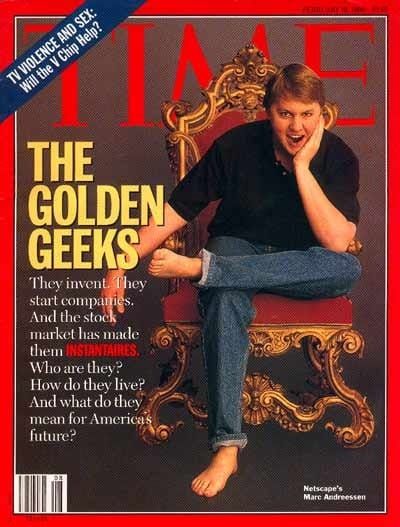
I have a problem with books. I read one, and instead of going to bed, I end up somewhere on the internet at 1 AM watching a 1996 interview with a 25-year-old Marc Andreessen on Charlie Rose.
I've been reading about the early history of the web. And somewhere in that rabbit hole, I kept bumping into the same name. Marc Andreessen. Co-creator of NCSA Mosaic, the browser that basically taught the world what a hyperlink was. Then, he co-founded Netscape, the company that turned that curiosity into something 40 million people were actually using.
And then I found the Charlie Rose interview. An hour long. From 1996. He was 25 years old. Just 25!
I watched the whole thing, took notes, and now I'm going to share my highlights with you, to get you to my rabbit hole :)
How Accurate Were They About Market Size?
He first said their customers were 80% businesses.
This was Netscape’s real gold mine. If a company wanted to have a website or an internal network (an Intranet), they needed server software to host it. Netscape sold these for huge sums.
And they were also licencing browser to B2B market. While it was free for students and individuals, companies were legally required to pay licence per seat. It was about 40$ per seat!
Marc also mentioned that analysts were projecting the enterprise internet market to hit $10 billion by the year 2000. Charlie Rose, doing his best impression of someone who has heard large numbers before, responds: “So in four years, it’ll be $10 billion.”
Marc basically nods and says yes.
I quickly double checked If I can find any reference from internet. I was lucky for this time. Here is direct quote from 1996:
And fast forward to 2000, global internet-related revenue was not $10 billion. Companies were valued at billions while making almost zero dollars, ends up with dot-com bubble.
Here is a 2020 Q4 report from IAB:
There were only 361 million Internet users in 2000, in the entire world. For perspective, that’s barely two-thirds of the size of Facebook today.3
So, it seems with dot-com bubble side effects he was interestingly lucky with that estimation!
Their Bandwidth and Television Numbers Compared to Today
Marc talks about cable modems offering "multi-megabit access" as a revolutionary future development. He mentions a service from TCI called "At Home" that was live in 8 to 12 cities and allowed people to get what he describes as "TV-quality picture" over the internet, if they had enough bandwidth.
"It depends entirely on the amount of bandwidth you have. If you have several megabits of bandwidth, megabits per second, you can get a TV-quality picture."
In 2026, I am streaming 4K video on my phone while waiting for a bus. My home connection is roughly 1,000 megabits per second.
Marc and Charlie were genuinely excited about the possibility of watching a grainy 240p clip over a cable modem in Sunnyvale, California. I find that both humbling and wonderful.
Marc's Projections About Internet Usage
"In 10 years, we probably won't even be talking about the Internet. You'll just assume it's there."
He said this in 1996. By 2006, he was more or less right. And by 2026, "the internet" has become such a foundational assumption of daily life that the word itself barely gets used anymore. We say "look it up," not "go on the internet and look it up."
The thing is, he wasn't just guessing. He was reasoning from a pattern he'd already seen: the telephone, electricity, running water. Technologies that start as remarkable novelties and end up as invisible infrastructure. He saw that arc and placed the internet on it correctly.
I think about this a lot when people talk about AI today. We're still in the phase where we say "I used AI to do that." In 10 years, who knows!
Infrastructure and Fiber
Marc mentions, almost in passing, that a lot of developing countries might "jump straight to fiberoptic backbones," skipping the intermediate stages of infrastructure that developed countries had to build through.
This is genuinely prescient. The concept of technological leapfrogging (where a country skips an older technology generation and adopts a newer one directly) became one of the more interesting development stories of the 2000s and 2010s. Mobile banking in Kenya is the classic example. Cheap smartphones as a first computing device across much of Asia and Africa is another.
He saw it coming. He just didn't have the case studies yet, because they hadn't happened.
How They Thought They Were Going to Make Money (And Why That Assumption Failed)
This one is fascinating and a little painful to watch in retrospect.
Marc is very clear about the business model: Netscape makes money by selling software to businesses. The web advertising revenue is almost a side note. He estimates around $20-40 million from advertising on total revenues of roughly $300 million.
"The way we make money is by selling the software."
The thing is, he was right about the model in 1996. Selling enterprise software was a real, profitable business. But Netscape was essentially trying to apply a 1980s software model (like Microsoft Word) to a 1990s delivery system. The problem is that the industry found a different answer to the question of "how do you monetize the web," and that answer was advertising at a scale nobody had imagined.
And speaking of advertising, let’s check what our magic duo was doing in 1996!
Wow! More or less same story as Marc Andreessen and NCSA Mosaic..
Google figured out that you didn't need to sell software if you could sell attention. And once that model took hold, the software licensing model for internet companies largely collapsed. You can't charge $50 for a browser when the browser is how you sell someone a $500 pair of headphones.
I actually had written about that online advertisement business while ago:
 Ufuk Şafak
To be fair: Netscape's model was not crazy. It was just outcompeted by a different model that turned out to be much, much bigger.
Their War With Microsoft
This is the most entertaining part of the interview, honestly. Charlie asks Marc whether Microsoft's goal is to put Netscape out of business.
Marc's answer:
"Microsoft's ambition is to drive everyone out of business. Those of us in the computer industry just assume that, right?"
He says this completely calmly, like it's the most obvious thing in the world. No drama, no outrage, just a mild acknowledgment of competitive reality from a 25-year-old who has clearly made peace with the fact that he is being hunted by the largest software company in the world.
At the time of the interview, Netscape had about 80% browser market share. Microsoft had Internet Explorer bundled with Windows and was beginning to bundle it for free as part of their enterprise suite. Within a few years, that market share would largely collapse.
What Marc doesn't say, but probably knows: you can't out-distribute someone who owns the operating system. The browser war wasn't really about browsers.
And I will read more about Browser wars. But for now, let’s keep reading our interview.
Charlie Rose Trying to Imagine the Smartphone
This might be my favorite moment in the entire interview. Actually, you should just watch that section. Go to link at jump to 49:38, please. Or just stay here and keep reading.
Charlie describes his ideal morning device: something he can push a button on and get news, weather, stocks, all the things the internet has, but in the same way a TV or newspaper delivers it. Simple. One-touch. Personalized.
Marc's response is essentially: "Oh, you mean like email? We have a thing called Inbox Direct, your New York Times shows up every morning."
They're talking past each other in the most interesting way. Charlie is describing a smartphone, or at least a tablet, with an app-based news feed. Marc is describing a newsletter subscription service. They are both reaching for the same idea from different directions, and neither of them quite gets there.
The actual version of what Charlie wanted would arrive about 11 years later, in 2007, with a device that could fit in his shirt pocket and would completely reorganize both of their industries. Nobody in that room knew that yet.
They Didn't Have Cellular Internet Yet
Marc is asked what the next big thing might be after the internet. He struggles a little with the question, which is charming given what we know now.
"Some new approach to networking that wasn't the Internet, some breakthrough technology, for example, for high-speed access that had nothing to do with the Internet."
He's essentially saying: the constraint is bandwidth, and the next big thing will be whatever solves bandwidth in a new way. Which is almost exactly what 3G, 4G, and eventually 5G did, except on a device that also made phone calls and played music and replaced the camera in your pocket.
The thing he can't quite see is mobile. Not because he's not smart, but because in 1996, cellular data was slow, expensive, and barely existed. It wasn't an obvious premise to build on.
What's interesting is how close he gets. He mentions that internet appliances might be subsidized by service providers and eventually be free, the same way mobile phones were being subsidized by carriers. He was reasoning correctly about the business model of a device he couldn't quite picture yet.
Who Is Going to Use Computers?
Marc draws a pretty clean distinction between two types of users: professionals who do "intellectually demanding work" (writers, designers, engineers) who will keep using PCs, and everyone else who might switch to simpler, cheaper internet appliances.
This maps surprisingly well onto what actually happened, just over a longer timeline and with a different device. The "internet appliance" turned out to be the smartphone, not the $200 box running simple web tasks that people imagined in 1996. And the distinction between "professional use" and "casual use" is still very much alive. I write this blog on a laptop. I read most of my news on a phone. Both of those things would have made complete sense to Marc in 1996, even if the specific devices wouldn't have.
Marc Is Trying to Sell an Idea Like a Language Model
Toward the end, Marc describes Inbox Direct: a service where content providers sign up, you get personalized news delivered to your mailbox every morning, filtered according to what you like, from sources like The New York Times and The Wall Street Journal.
Charlie immediately wants it. "How do I get this tomorrow?"
What Marc is describing is, functionally: a curated feed of content, personalized to your preferences, delivered automatically. In 1996, it was called Inbox Direct. In 2026, it is called approximately fifteen different things by approximately fifty different companies, several of which are trying to add AI to the curation layer and call it a breakthrough.
The idea hasn't changed. The infrastructure has just gotten a lot more complicated, and someone has added a chatbot to the front of it.
The interview is on Charlie Rose's website if you want to watch it yourself. I highly recommend it.
Me, I keep reading about History of Technology. I think my next show at Charlie Rose website is 1996 Steve Jobs Interview.