The Man Who Got Paid to Lie With Math
Economists with charts. Corrupt loans. Plane crashes. John Perkins spent a decade helping build a global debt machine, then spent twenty years deciding whether to talk about it. Here's what he said.
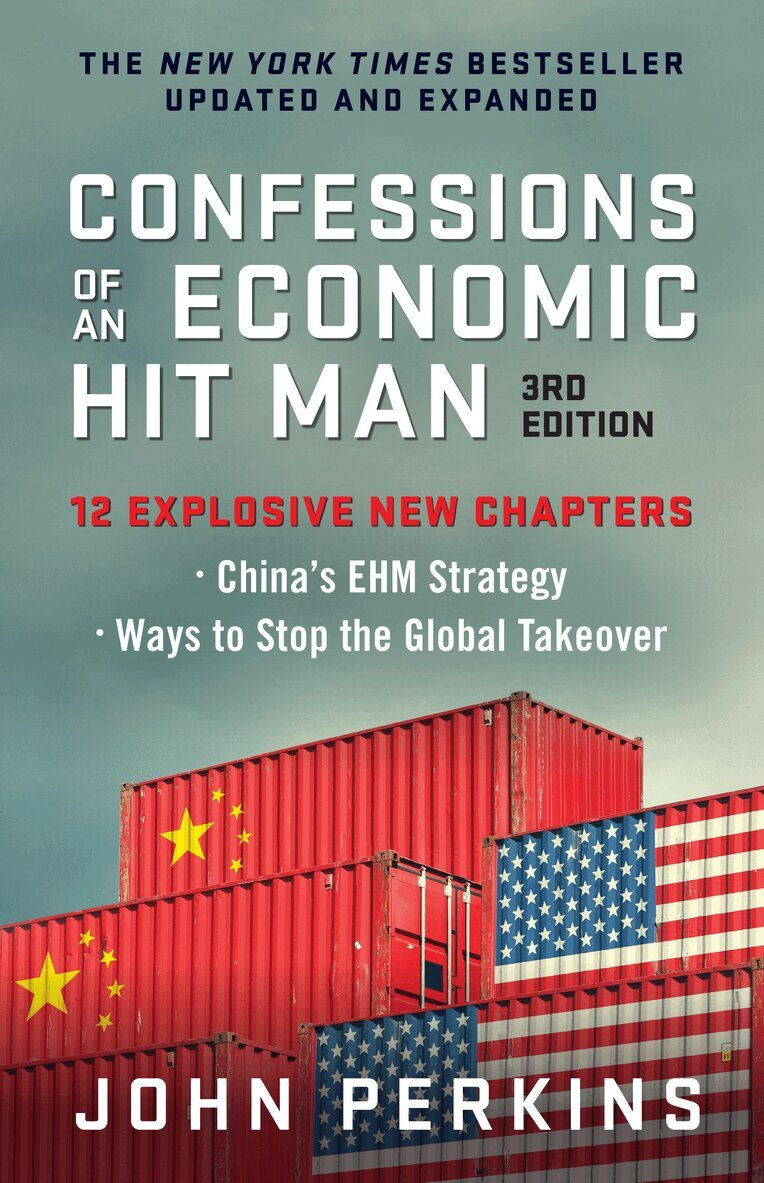
I picked up Confessions of an Economic Hit Man about eight years ago. It was first year in my life that I read more than 10 books! It was the year I did my military service 😄
Then, a few weeks ago, someone in a podcast I was listening to mentioned John Perkins again. And I remembered I should start re-reading some books I read! I found my old notes, started digging, and basically lost an entire day to this rabbit hole. Now, I need to read latest version of this book, basically because he added a lot of contents about China! But before reading it, I am doing something unusual. Writing a personal reflections after 8 years 😄 That is what true procastination means.
I am not an economist, not a political scientist, and definitely not qualified to validate or debunk Perkins' claims. What I am is someone who finds this stuff genuinely fascinating and thinks you might too.
So, What Exactly Is an Economic Hit Man?
The title sounds like a conspiracy thriller. And honestly, reading it feels a bit like one too. But let me try to explain the concept plainly.
Perkins defines an economic hit man (EHM) as a highly paid professional whose job is to convince developing countries (usually ones sitting on valuable natural resources or strategic geography) to take on massive loans from international institutions like the World Bank or the IMF.
Perkins was one of them for a while. And somehow he decided to write his memoirs after almost 20 years. He had mostly referred things happened around 70's.
Obvious claim is that the money doesn't really go to the country. It flows directly to the big American engineering and construction firms (Bechtel, Halliburton, Chas. T. Main) that win the contracts to build the dams, power plants, and highways the loan was supposed to fund. The country ends up with an infrastructure it may or may not need, a debt it almost certainly cannot repay, and a very uncomfortable relationship with whoever holds that debt.
When you cannot pay your debts, the lender asks for favors. A vote at the UN. A military base. Oil rights at below-market prices. That is the system, in its simplest form.
That is quick summary of it. But I want to highlight details as well.
Who Is John Perkins, and Why Did He Eventually Talk?
Perkins spent about a decade working as chief economist at Chas. T. Main, a Boston-based international engineering consultancy. Before that, he did Peace Corps work in Ecuador, which is where, he says, the NSA first took notice of him. The selection criteria, as he describes it, were: intelligent, willing to follow authority, and morally flexible enough to rationalize what was being asked. Three for three, apparently.
He started writing this book in the early 1980s. He stopped four times. Each time, either a threat or a very generous consulting contract appeared at exactly the right moment. He describes this as a "golden handcuff" system: you don't need to threaten people with violence when you can simply pay them to stay quiet and comfortable.
Then September 11, 2001 happened. And Perkins, watching the footage, had the thought that a lot of people had but fewer said out loud: we helped create the conditions for this. Decades of economic manipulation and the propping up of corrupt regimes don't disappear quietly. They accumulate.
He published the book in 2004. The US government didn't try to stop it. The market mechanism worked as intended: enough people dismissed him as a conspiracy theorist that the book became a bestseller without becoming policy-changing.
How the System Actually Works: Three Steps
Perkins describes the escalation ladder quite clearly, and I find it useful to walk through it step by step.
Step 1: The Economic Hit Men. People like Perkins go in first. Their job is to produce economic projections that show absurdly optimistic growth rates for the target country, justifying enormous infrastructure loans. If a country can supposedly grow its economy at 17% per year (a number Perkins himself admits was completely fabricated for Indonesia), then of course it needs a new power grid and a deep-water port. The reports look rigorous. They have regression analyses and charts. Nobody questions the assumptions underneath.
Step 2: The Jackals. If the EHM fails, meaning the country's leader refuses to cooperate, declines the loans, or starts talking to alternative investors (Japan, for instance), then a second group shows up. These are people with CIA connections whose tools are coups, assassination attempts dressed up as accidents, and occasionally just the credible threat of both. Omar Torrijos of Panama and Jaime Roldós of Ecuador both ended up dead in plane crashes within two months of each other! Perkins says this was not a coincidence. I cannot prove he's right, but I also cannot pretend the timing isn't uncomfortable.
Step 3: The Military. If even the jackals fail, you get Iraq. This is the least subtle option, and also the most expensive, both financially and in terms of the thing we used to call "international reputation." The logic is the same as steps one and two; the method is just louder. You still end up with privatized state assets, foreign firms winning reconstruction contracts, and a country structurally dependent on outside capital. You just had to send soldiers there first to make it happen.
Statistics as a Weapon
This is the part I find most interesting as an engineer, because it is fundamentally a story about how numbers can be dressed up to mean whatever you need them to mean.
Perkins' core technique was what he calls "economic modeling." You take real variables, apply real-looking regression analysis, and then quietly adjust the growth assumptions until the output justifies the project you were sent to justify.
The "success" of this approach relies on something that's still very much true today: most people, including most decision-makers, will not question a number that comes attached to a chart and a 60-page report.
One number worth sitting with: when Perkins modeled Indonesia's electricity needs in 1971, he projected growth rates that implied the economy would roughly double every four or five years. For reference, the actual long-run average for a fast-growing Asian economy during that period was something closer to 6-8%. He produced 17%. It got approved.
Chronological Examples: The Case Files
This is the part where we go through actual history. I want to be clear: Perkins is a first-person narrator with an obvious ideological perspective, and some of his specific claims have been challenged by historians. I'll try to flag where the consensus is murky. But the broad structural patterns he describes are not seriously disputed.
1944: Bretton Woods, and Why the Dollar Won
Forty-four countries sent 730 delegates to a hotel in New Hampshire in 1944 to figure out how the post-war global economy would work. Two main proposals were on the table.
John Maynard Keynes, representing Britain, proposed a new neutral international currency called the "bancor," linked to gold and managed by a new multilateral body. The idea was to prevent any single country from having structural economic dominance.
The American delegation proposed something simpler: the dollar becomes the world's reserve currency, pegged to gold (at $35 per ounce), and every other currency is pegged to the dollar. The IMF and World Bank are created to manage this system.
The American proposal won. This is less surprising when you consider that World War II had not touched a single American factory, while Europe and Asia were largely rubble. The US held most of the world's gold and produced most of its manufactured goods. Forty-three other countries accepted dollar hegemony because they didn't have much choice.
The IMF and World Bank were born from this moment. Understanding that origin helps explain a lot about whose interests they have historically served.
1968: Ecuador, and a Young Man Gets Recruited
Perkins was doing Peace Corps work in the Ecuadorian Amazon. His official job was teaching local communities how to make bricks. Nice and innocent.
In reality, the reports he was writing ended up in the hands of American oil companies who were planning pipeline routes through the rainforest. To extract the oil, they needed roads and pipelines going deep into the jungle. Perkins' actual job was to map the communities along those routes, essentially identifying where resistance might come from. He says he didn't fully realize this at the time. He pieced it together later. Which, honestly, is probably how most of this stuff works. Nobody sits you down and explains the whole plan. You just do your part and try not to ask too many questions.
Meanwhile, the NSA was quietly running personality screenings on university campuses. Perkins fit the profile.
1971: Indonesia, and the Art of Inflating numbers
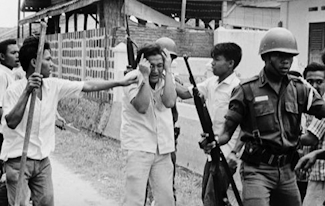
His first major assignment. Indonesia had been "opened up" to American economic interests following the CIA-supported coup of 1965, which led to the massacre of somewhere between 500,000 and one million people, most of them accused of communist sympathies.
Perkins was sent to Jakarta to model the island's electricity needs. He produced projections showing growth rates of around 17% annually. The World Bank approved a massive infrastructure loan. The money went to American firms. Indonesia got the power plants and the debt.
But wait, Indonesia became a great economy. I am writing this from 2026. And from 1971 to today, I believe Indonesia is the new asian tiger.
Indonesia today is a G20 member with a GDP around $1.4 trillion. Poverty has fallen from above 60% to under 10%. By standard metrics, this looks like a development success story.
They are projected to be 4th biggest economy by 2075. First time I saw their names within these list, I got surprised. Now with all information I remembered from that book, I am not sure...
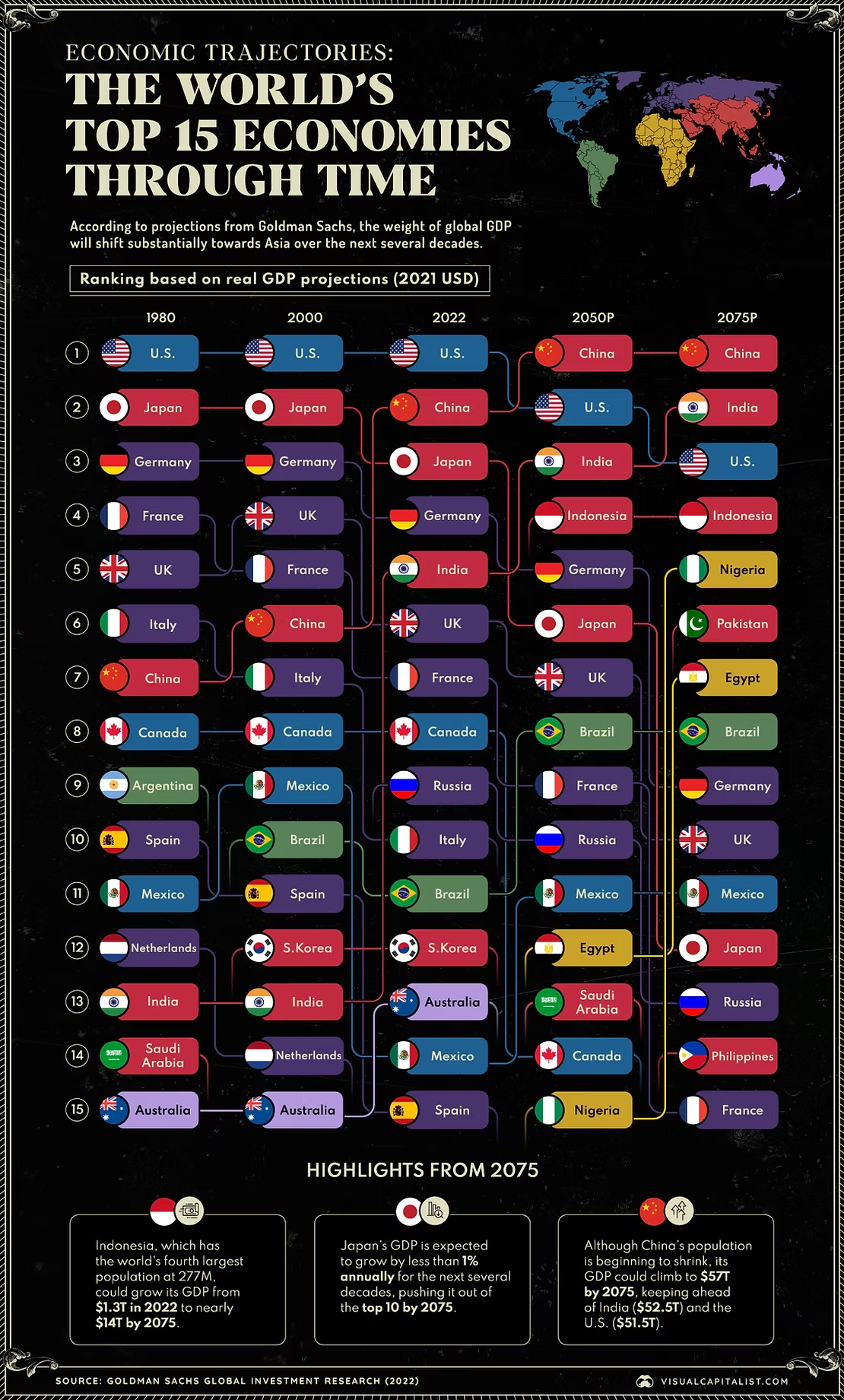
If I have a time, I need to dig dive into Indonesia case! If you are reading this sentence, it means I couldn't find a time yet 😦
Perkins would argue, and I think he has a point worth taking seriously, that the question isn't just whether the economy grew, but who captured the growth and at what cost. The natural resources (oil, gas, timber) were extracted at prices set largely by foreign firms for decades. The debt load has been a persistent constraint on public investment. The environmental damage in Kalimantan and Sumatra is not reflected in any GDP figure.
Whether a different development path would have produced better outcomes is genuinely unknowable. Indonesia without American infrastructure investment might have been richer and more sovereign, or it might have been poorer and more chaotic.
Panama Canal and Omar Torrijos
Panama in 1903 signed a treaty handing the US essentially permanent control over the Canal Zone: a strip of sovereign American territory cutting the country in two, where Panamanian law did not apply.
By the late 1960s, Omar Torrijos had come to power via a coup and was pushing to renegotiate this arrangement. He is one of the characters in Perkins' book that comes across as genuinely admirable, which in the context of this book is a statistically dangerous position to occupy.
Torrijos refused the loan offers. He was negotiating with Japanese investors for an alternative canal project. He eventually got a new treaty with Jimmy Carter in 1977 that returned the canal to Panama.
In 1981, his plane went down...
Perkins says it was a bomb. The official investigation said mechanical failure. How the crash happened remains a mystery, and many people still believe it was an assassination. What happened next is complicated though: Panama fell into political instability, Noriega eventually took power, and the country became something quite different from what Torrijos had been building. The canal did return to Panama in 1999, as the treaties had promised. Whether that counts as a win for Panamanian nationalism, or just a delayed outcome that served everyone's interests by then, is a question worth sitting with.
1973: The Saudi Deal, or How the Dollar Survived Losing Gold
In 1971, Nixon ended the dollar's convertibility to gold. The dollar was now just a piece of paper backed by... confidence in America, essentially. This was a significant structural problem for the reserve currency of the entire world.
Then came 1973. The Yom Kippur War. Egypt and Syria attacked Israel, the US supported Israel openly, and OPEC responded with an oil embargo. Prices quadrupled. The American economy nearly seized up.
The deal that Perkins helped engineer (in a supporting role, he's careful to note) was elegant in a bleak way: the US agreed to protect the Saudi royal family militarily and help modernize Saudi Arabia. In exchange, the Saudis agreed to sell oil exclusively in dollars, and to invest their dollar surpluses in US Treasury bonds. The petrodollar system was born.
The dollar no longer needed gold to back it. It needed oil. And oil needed to stay denominated in dollars. Every country that needed to buy oil now needed to hold dollars first. American monetary hegemony was essentially repackaged and continued.
The "modernization" of Saudi Arabia was, according to Perkins, largely an exercise in billing: enormously inflated contracts for infrastructure projects where the budget-to-output ratio was, let's say, generous. Riyadh got highways through the desert and the invoices went to Riyadh.
1975: Iran and the Shah's Ambition
The Shah of Iran had oil money and large ambitions. He wanted Iran in the top five global economies. This, from an EHM perspective, is a beautiful target: a leader who wants things and has money to spend on them.
The contracts flowed. Nuclear plants. Advanced fighter jets. Infrastructure. The Shah was, as Perkins puts it, convinced he was getting modernization when he was actually getting dependency.
The problem was that no economic model captures cultural and religious variables. The regression analyses didn't have a row for "percentage of population that views the Shah as a Western puppet."
1979: The Revolution Nobody in Washington Properly Predicted
The Shah was overthrown in January 1979. France, Britain, the US, and Germany had quietly agreed, at a meeting in Guadeloupe, that he was no longer worth defending.
Khomeini came back from Paris. The logic, apparently, was that Islamic movements could be useful buffers against Soviet communism. The term Perkins uses is "green belt," the idea of using Islam as a wall against communist expansion in the Middle East and Central Asia.
1990: Iraq
Iraq had been a useful partner during the Iran-Iraq war, which the US largely supported on the Iraqi side. When Saddam Hussein invaded Kuwait in 1990, he became inconvenient instead.
The 1991 Gulf War, the sanctions throughout the 1990s, the oil-for-food program that Perkins argues was designed to extract Iraqi sovereignty while keeping the population just stable enough, and then the 2003 invasion: this is the sequence.
What happened after 2003 was a fairly direct application of the EHM formula, except without any pretense of the country consenting. 200 state-owned enterprises were privatized. A law was passed allowing the profits to leave the country tax-free. Traditional seed-saving practices that had existed for thousands of years were made illegal, replaced with mandatory GMO seed purchases.
Perkins' point is that even "regime change" ends up following the same economic template.
1999: Bolivia and the Water Wars
Bolivia had been through IMF structural adjustment in the 1980s: privatize, deregulate, accept foreign capital. The price was a debt spiral that never really ended. The IMF's conditions included privatizing the water distribution system in Cochabamba, Bolivia's third-largest city.
Bechtel won the contract. Water bills immediately doubled or tripled for some families. And then came Law 2029: any community water system inside the concession area, the wells and cisterns that local people had built themselves with their own money, now legally belonged to Bechtel. No compensation. The water was no longer yours, even if you dug the well.
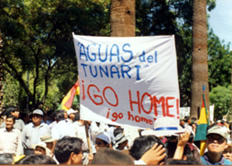
The city shut down. General strikes, road blockades, barricades. A 17-year-old named Víctor Hugo Daza was shot and killed by the Bolivian army during the protests. In April 2000, after weeks of escalating chaos, the government told Bechtel they could no longer guarantee the safety of their executives. Bechtel left. The privatization was reversed.
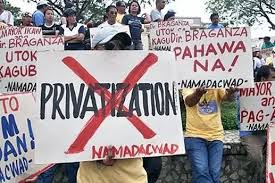
It is one of the very few examples in the book where the system didn't win. Worth noting.
The Modern Version: China's Belt and Road
Perkins argues, in the updated editions, that China has essentially taken the EHM playbook, removed the democracy-and-human-rights conditions that made Western loans politically complicated for authoritarian recipients, and scaled it up considerably.
The Belt and Road Initiative offers infrastructure financing to countries that Western institutions often won't touch. The loans are large, the terms are sometimes opaque, and when countries can't repay, strategic assets tend to change hands. Sri Lanka handed the Hambantota Port to China on a 99-year lease in 2017. A version of this is playing out in Kenya, Ethiopia, and several others.
Perkins doesn't frame this as "China is evil, America is good." His point is that both powers are running the same fundamental system: debt as leverage, infrastructure as dependency, strategic assets as collateral. The color of the flag on the loan document is the least interesting part of the story.
And, that part is why I need to re-read this book! Because, I want to understand China culture and their success story.
The Organizations Behind the System
It wouldn't be fair to just wave at "the system" without naming the specific institutions. Three worth understanding:
The World Bank was created at Bretton Woods and is nominally a development institution. In practice, its president has historically been an American (this was an informal rule for decades). Its loans come with conditions. Those conditions often require privatization, deregulation, and opening markets to foreign investment. Whether this helps or hurts the recipient country in the long run is genuinely debated. What is less debated is that the contracts that flow from World Bank-funded projects disproportionately go to firms based in donor countries.
The IMF (International Monetary Fund) was also a Bretton Woods creation. It functions as a lender of last resort for countries in financial crisis. The catch is that its loans come with "structural adjustment" conditions: cut public spending, privatize state assets, liberalize trade. These conditions have been blamed for deepening poverty in a number of countries, most notoriously in Argentina in the late 1990s and early 2000s. The IMF has acknowledged, to its credit, that some of its past prescriptions were too rigid. Whether this has changed its actual lending behavior is a separate question.
USAID is officially the US government's foreign aid agency. Perkins' specific claim is that USAID projects are often structured to create dependency on American expertise and infrastructure, opening markets for American firms rather than genuinely building local capacity. USAID has funded a lot of genuinely good work in public health and disaster relief. It has also funded a lot of things that served American strategic interests more than recipient-country interests. Both can be true.
Final Thoughts
I want to be honest about what this book is and isn't.
Perkins is a first-person narrator of his own moral awakening. He is not a neutral observer. Some of his specific claims, particularly around the assassinations, are based on inference and circumstance rather than documentation. The historians who have pushed back on him have real points.
And yet: the structural pattern he describes, debt as leverage, statistics as cover, institutional revolving doors, the gap between development rhetoric and actual outcomes, is not seriously disputed. You can find versions of the same analysis in peer-reviewed academic economics, in the IMF's own retrospective assessments, in investigative journalism.
"You no longer need to bomb a country. Lowering its credit rating is enough."
That observation doesn't require you to believe every detail of the assassinations to be a useful lens on how the world currently works.
And honestly, using debt and infrastructure investment instead of conquest does seem like a more peaceful arrangement than open war. After World War 2, the US built what people call Pax Americana, a global order shaped around American power. They rode that into the 2020s. Now it's visibly shaking, and I'm not sure what comes next or how they respond.
No country is purely evil or purely innocent. Some cultures produced more advancement than others at certain moments in history. But at some level, I believe every human being is a nationalist. The smallest circle is just yourself, then your family, your city, your country. You can't say I don't give a fuck to anyone beloved. I can't entirely blame any nation for consolidating power when history handed them the opportunity. That's more or less what every empire in history has done.
What I do think, after reading a lot of American history from both the political and technological side, is that the US built something genuinely impressive. But their particular era seems to be closing. We're going to witness what comes after, and they are openly saying so themselves.
I kept reading about techno-feudalism, techno-oligarchs, and how American democracy is under attack from within. Which raises an uncomfortable question: did the US genuinely believe in the democratic values it spent decades exporting, or was democracy always partly the packaging rather than the product? I honestly don't know. Both things can probably be true at different moments, for different people, inside the same system.
What I do know is that American democracy is not the same thing as European democracy. In US, it is normal for corporations and billionaires to spend unlimited money on political campaigns. You can openly buy political influence in America in a way that would be illegal or deeply scandalous in most of Europe. Which democracy is more realistic?
YES! I am questioning the real value of Democracy 😄
And while this blog post draft is waiting for me to publish, Palantir tweeted a manifesto. I'm planning to write about the Palantir manifesto next, which feels like a relevant follow-up to everything in this post.
I'll write another post after I finish the third edition. There's also a lot I left out deliberately, the Marshall Plan, American influence on Turkey specifically, the broader Cold War architecture. I wanted to stay close to the book this time.
References
 Contributors to Wikimedia projects
 Deepak D.
 Contributors to Wikimedia projects