Who Owns the Internet (And Why You Should Care)
What I learned about the internet by accidentally downloading the wrong audiobook at an airport.

I finished James Ball’s The System: Who Owns the Internet, and How It Owns Us last week. Published in 2020. Still relevant. Annoyingly so.
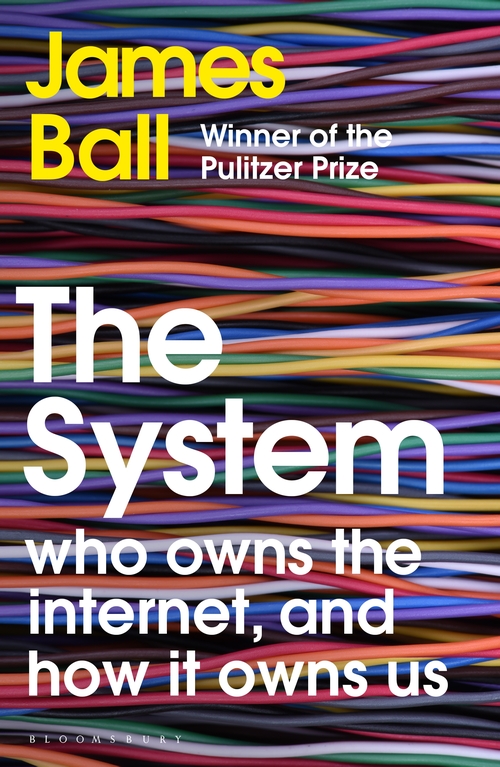
I want to be upfront: this is not a summary. There are plenty of those on the internet. This is just me telling you whether I think you should read it and what it made me feel.
I picked this up literally becaue I had a flight an need a 3 hours long audiobook about Systems Engineering. And I found that book, name is system but book doesn’t relates to Systems engineering that much. But within 5 minutes before take off, I didn’t have much time to decide. So, I downloaded and listened to half of it at flight :)
The thing I appreciated most is that Ball does not treat the internet as a story of villains. That would have been easier to write and probably more satisfying to read. But it would have been wrong. What he shows instead is how a set of reasonable decisions, made by reasonable people, each following their own logic, added up to a system nobody would have consciously designed. The surveillance, the monopolies, the governance gaps. Nobody sat in a room and said “let’s build a tool for mass data extraction and call it social media.” They just kept making the next reasonable business decision until that is what they had built.
That framing hit me harder than I expected.
I am also an engineer. I am trying to make reasonable decisions every day. I build things inside systems I did not design. And I think most of us do not spend enough time asking what those reasonable decisions are accumulating into.
And I personally believe there mostly just grey people. No one, literally no one is brutally evil or an angel with white wings. Although I don’t want to refer to “50 shades of grey” movie, there are just shades of grey :D
So, all those grey people including me trying to solve problems. As we solve previous problems, we are creating new problems. For internet phenomenon, I personally believe it was very good improvement for society. But as I am also suffering from attention economy, I am not big fan of latest situation of technology industry.
So, the book takes on the question of how the companies that once said "we will change the system" became the system itself. Ball answers it in three layers.
Mechanism. The internet is not a cloud. It is cables, servers, and physical infrastructure owned by specific companies in specific countries. Ball grounds the whole book in this reality early on, and it reframes everything that follows. Whoever controls the pipe controls the flow. That was true for railroads in the 19th century, and it is true for fiber optic cables today. Intelligence agencies understood this before most technologists did, and they acted on it accordingly.
Architects. The people who built the early internet were a small group of academics who trusted each other completely. They designed protocols for a closed, trusted network. No security layer, no privacy layer, no authentication, because why would you need any of that between three universities that all know each other? The governing bodies that emerged later, like ICANN which manages domain names, were born under specific national influences and have never fully escaped them. The internet’s “constitution” was written by a very small room of people, and the rest of us inherited it.
Money. This is the section that changed how I use my browser. The advertising model that funds most of the internet requires maximum data collection by design. It is not a side effect. You visit a page, and before the ads load, your browser has already broadcast your existence to dozens of exchanges running a real-time auction. Companies that lose that auction still receive your data. They just did not win the right to show you the ad. The venture capital logic compounds this: grow fast, optimize for engagement, worry about the consequences later. Or never.
I am going to deep dive into online advertisement more. But not now. I did dive into that topic before:
 Ufuk Şafak
I believe that is one of the topics we need to discuss more for modern day problems.
There are a couple of things in the book I did not know before reading it, and they genuinely changed how I think.
The first is that advertising system I just described. After reading that chapter I went and checked what I had been consenting to by clicking "Accept All" on GDPR banners for years. I had cookies from over 4,000 websites. You can actually delete them. It is probably the most concrete privacy improvement you can make in an afternoon.
The second thing is the role of physical infrastructure. The cables, the companies that own them, the geography that determines who has leverage over what. I actually wrote a separate post about this right after finishing the book:
 Ufuk Safak
But Ball was the one who made me take it seriously as a power structure, not just an engineering detail.
And the last detail that I keep thinking about: the internet became a public, commercial thing in 1990s. The Apple I came out in 1976. That is almost two decades of personal computers existing without any internet. People were writing software, shipping software with disks, building products, running entire businesses, all offline. Today you cannot do much of anything on a smartphone without a connection. That shift happened within a single generation, and I think we have not fully processed how strange that is.
And the very beginning of all this? The first message ever sent over ARPANET was supposed to be "LOGIN". The receiving computer crashed after two letters.1 The first word the internet ever said was "LO". They were just universities trying to share processing power. Nobody was trying to build something that would end up owning our attention.
The book is not perfect. The final section on activism and resistance feels thinner than the rest. Ball profiles organizations doing good work on digital rights, but it reads like he ran out of momentum right when you most want him to commit to a point of view. The first two thirds build a solid, specific argument. The ending gestures at hope without quite earning it. That said, the organizations worth knowing are real. The Electronic Frontier Foundation has been fighting for digital rights since 1990, mostly in the legal and policy space. Access Now operates more globally, specifically defending the rights of users in the Global South, which is at least an attempt to address what Ball's book misses.
Also, Ball admits this himself: the whole story is very Western, very Anglo-American. The billions of people who came online in Africa, South Asia, and Southeast Asia mostly joined a system that was already built and optimized for someone else. Their experience of the internet is a different story that this book does not really tell. That is worth keeping in mind.
Another thing worth keeping in mind, not from the book, is that today’s technology world has a big player named China. I personally keep reading about how to design a good system from Western sources, but there is an undeniable fact that China is very good at engineering. They built a national network infrastructure at a scale and speed that the West largely has not managed, and they are laying submarine cables and building data centers across Africa and Southeast Asia right now. Whether you agree with their approach or not, ignoring it seems like a mistake.
While solving modern problems, I believe we should always look to both sides of the world.